
The Invisible Detail That Ruins a Dining Experience (It’s Not the Service)
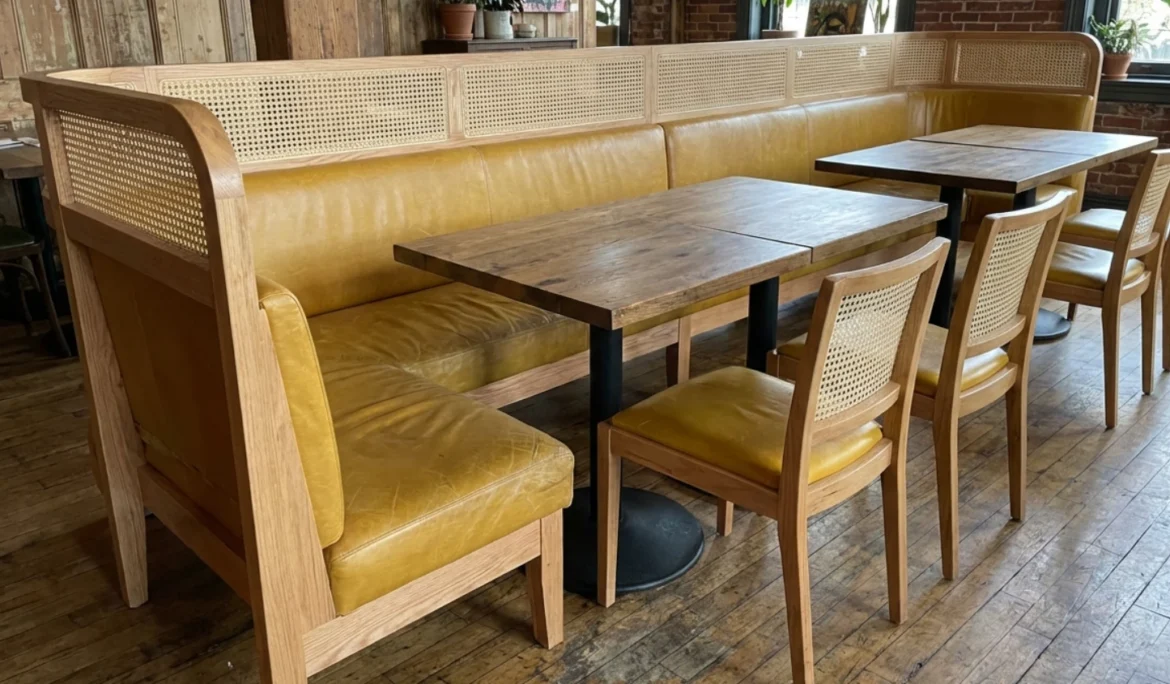
We talk a lot about “atmosphere” in the hospitality business. Usually, when people use that word, they are pointing at the lighting fixtures, the wall art, or the volume of the music. And while those things set the mood, they don’t determine the physical endurance of your customer.
There is nothing quite as distracting as a bad seat.
You have likely experienced this yourself. You are at a networking dinner or a date night. The restaurant is beautiful. The appetizers land on the table. But about thirty minutes in, you catch yourself shifting your weight. You cross your legs. You uncross them. You lean forward on your elbows just to take the pressure off your lower back.
Suddenly, you aren’t listening to the conversation anymore. You are managing your own discomfort.
As a local workroom here in Van Nuys, we have seen the insides of thousands of restaurant booths and hotel chairs. We take them apart when they fail. And let me tell you, what we find inside the “bargain” furniture explaining exactly why customers don’t stay for that second round of drinks.
The “Three-Month” Foam Trap
When you are building out a restaurant or a lobby, the budget is always tight. We get it. You are looking at a line item for custom banquettes versus ordering something pre-made online that promises to arrive in two weeks.
The pre-made stuff looks great in the photos. And honestly? It usually feels okay fast when you first unbox it. That is because manufacturers of mass-produced commercial furniture often use low-density poly foam that is specifically designed to feel plush *initially*.
We call this “showroom comfort.” It sells the chair.
The problem arises around month three or four of heavy commercial use. A popular restaurant seat might see 50 to 100 different bodies in a single week. That is constant compression and friction. Low-quality foam has a weak cellular structure. Under that kind of stress, the air pockets inside the foam burst and collapse.
Once those cells collapse, they don’t bounce back. The seat becomes a pit.
When a customer sits in a collapsed seat, two things happen. First, the upholstery fabric starts to wrinkle and pool because the tension underneath is gone (which makes your place look messy). Second, and more importantly, the customer hits the hard deck—the plywood or the springs underneath.
This subconsciously signals to the guest: *This place is worn out. They don’t care about details.*
The Science of “High Resiliency”
When we build custom booths or re-upholster commercial seating for our Los Angeles clients, we push hard for High Resiliency (HR) foam. It isn’t an upsell for the sake of profit; it’s a protection policy for your furniture.
HR foam is chemically different. It has a higher support factor, meaning as you push down on it, it pushes back with increasing resistance. This is crucial for commercial settings because it accommodates a wide range of body types. A 120-pound guest and a 300-pound guest can both sit comfortably on properly rated HR foam without bottoming out.
It’s about longevity. A standard block of cheap foam might lose 20% of its firmness in six months. A high-quality HR block might lose only 2% in that same timeframe.
If you calculate the cost of reupholstering your entire dining room everyday two years versus every seven or eight years, the “expensive” foam is actually the cheapest option by a landslide.
It’s Not Just About Softness—It’s About Geometry
One thing that often gets overlooked in commercial design is the relationship between the seat height and the table height.
Standard commercial dining tables are roughly 30 inches high. For comfortable dining, the compressed seat height needs to be around 18 to 19 inches.
If you buy cheap cushions, a customer sits down and sinks three or four inches. Now they are sitting at 15 inches. Suddenly, the table feels like it is at their chest level. They feel like a child. It is awkward to cut food, and it feels socially diminishing.
We meticulously calculate “compression rates” when we build custom seating. We know that if we use a specific density of foam, it will only compress an inch when someone sits. This keeps your guests at the proper eye level with their dining companions and at the proper ergonomic height for eating.
This is the level of detail that separates a *fine* experience from a *great* one. Users rarely notice when the height is perfect, but they instantly notice when it’s wrong.
Restoring vs. Replacing: You Might Have Good Bones
We work with a lot of restaurant owners in the Valley and greater LA who think they need to throw everything out and start over because their seating is uncomfortable.
Often, that isn’t true.
If you have quality frames—good, heavy wood, solid joinery—we don’t need to toss them. We can do a “foam intervention.” We can strip the piece down to the frame, check the springs/webbing (and tighten them, because they often sag too), and rebuild the seat with a multi-layer foam system.
We often use a technique called lamination. We might glue a layer of very firm, dense foam on the bottom for stability, a middle layer of medium HR foam for support, and a top layer of softer foam or Dacron wrap for that initial plush feel.
This gives you a custom feel that feels brand new, usually for less than the cost of buying high-quality new units. Plus, you get to keep the layout and style that fits your space perfectly.
The Hygiene Factor
We should also touch on what happens inside cheap foam when spills happen. And in hospitality, spills *always* happen.
Low-grade open-cell foam acts like a sponge. If wine, soda, or soup gets through the fabric, it goes straight into the foam bun. You can clean the fabric surface, sure, but you can’t clean the inside of the foam. That creates odors and bacteria growth over time.
When we do commercial projects, specifically for bars or high-traffic booths, we can wrap the foam core in a barrier layer or use specific closed-cell foams that resist moisture absorption. This keeps the “guts” of your chair clean, even if Saturday night gets a little rowdy.
Comfort Converts to Revenue
The math is simple. If a chair hurts, people leave. If people happen to be comfortable, they linger. They order dessert. They order coffee. They look at the cocktail menu again.
Your furniture is an employee. It works for you from the moment you open until the moment you close. It shouldn’t be the weakest link in your business.
Whether you are looking to build brand new custom booths for a grand opening or you need to resuscitate the existing seating in your current venue, give us a call or stop by our shop. We can show you the different foam densities. We can let you sit on the sample blocks.
Don’t let a twenty-dollar piece of cheap foam be the reason you lose a hundred-dollar dinner check. Investment in comfort always pays dividends.
